What is the boneyard in Ostranauts?
The K-Leg boneyard — a wreck field near OKLG packed with derelict ships to strip via EVA. It is the default early income source.
Ostranauts salvage guide: board K-Leg boneyard derelicts, strip high-value modules, manage EVA oxygen, sell at Scrap and License kiosks, and return alive.
Boneyard derelict boarding — approach wrecks, EVA prep, and strip runs that pay down OKLG debt.
~10 min read
Sponsored
Ostranauts salvage is the core income loop in Blue Bottle Games' hardcore space life-sim — published by Kitfox Games, 1.0 on Steam August 3, 2026 (App 1022980). This Ostranauts salvage guide covers K-Leg boneyard derelicts, EVA boarding, strip priorities, OKLG kiosk sales, and permit timing so you return alive with cash left after mortgage. Verified August 16, 2026 · Steam.
| Fact | Detail |
|---|---|
| Primary field | K-Leg boneyard near OKLG station |
| Activity | EVA boarding of derelict hulls |
| Permit | ~$5,000 · 24 hours · Licensed Salvage kiosk |
| Low-value sales | Scrap kiosk — damaged tiles and junk |
| High-value sales | Licensed kiosk — intact modules, rare parts |
| Starter debt context | Loan ship ~$100k — salvage must cover mortgage |
| Related systems | EVA suits · tools · transponders · towing |
The boneyard (officially the wreck field off K-Leg / OKLG) is a dense cloud of abandoned hulls — tugs, freighter chunks, and stripped frames left after Kessler Syndrome choked off Earth traffic. It is where new captains learn EVA because wrecks are close, static relative to station traffic, and full of parts OKLG traders still buy.
Fuel and RCS are finite on a loan tug. Boneyard targets sit minutes from dock, not hours. You can abort a strip, sell junk the same cycle, and still cover ~$100k mortgage bills. Deep-system derelicts pay more per module but assume spare O₂, permit timing, and often a tow brace — mid-game problems.
Expect unpowered, cold, and already vented hulls — no atmosphere, flickering emergency lights if any. Some ships still hold pressurized rooms (check door status before you cut). Treat every intact compartment as a leak waiting to happen until you scan with DmgViz or visually trace cracks.
OKLG sells 24-hour salvage permits that legalize high-value trading and reduce run-ins with station security. You can strip without one, but selling premium modules at the Licensed kiosk and bluffing through inspections gets expensive. Pair permit purchases with your best haul days, not exploratory hops.
Salvage starts with Newtonian flight — matching the wreck's vector, killing relative velocity, and mooring or EVA-jumping from a stable offset. Crash into a hull and you pay in repair bills before you cut a single tile.
| Phase | Control | Goal |
|---|---|---|
| Undock | Nav console · clearance · RCS | Leave OKLG without collision |
| Transit | RCS taps · watch VREL | Close distance without overshoot |
| Match velocity | Opposite RCS to target vector | Relative speed near zero |
| Hold position | Micro-burns · tether range | Stable platform for EVA exit |
| Return | Same fuel reserve you budgeted outbound | Dock with loot and O₂ to spare |
The nav console shows VREL — how fast you are sliding past the target. Zero it before you open the airlock. Loan ships are heavy; start braking early. If you pass the wreck, loop wide rather than brute-forcing a spin — RCS gas is cheaper than hull patches.
Small wrecks allow EVA jump from a parked tug a few meters off. Larger hulls may need a soft dock or manual alignment along a maintenance rail. Never EVA while the ship still drifts — you will separate with momentum you cannot recover without wasting suit jets.
First visit: place a beacon mental note or screenshot the tug orientation relative to the wreck. Returning with full bags, it is easy to enter the wrong breach or lose sight of your ship against station glare.
Salvage speed is tool-bound. The wrong cutter means frozen progress while O₂ ticks down.
| Tool | Example brands | Best on |
|---|---|---|
| Crowbar | Weber Prize | Loose panels · fast pry |
| Hacksaw | Horang PlastHak | Structure · hull tiles |
| Angle grinder | Gott | Metal structure · faster cuts |
| Power drill | Gott · Horang PlaScrew | Fasteners · modules |
| Laser torch | Weber Lance | Precision cuts · higher skill |
| Welder / solder | Various | Install later on your ship — optional on strip |
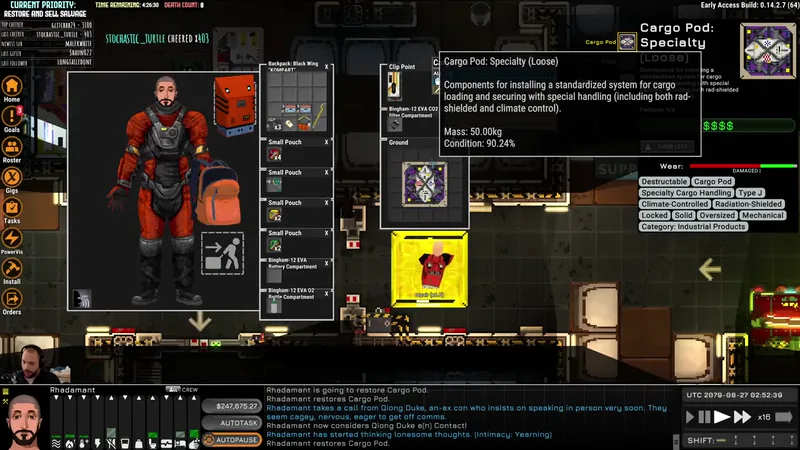
Crowbar, charged EVA suit, full O₂, headlamp, and one cutting tool (hacksaw or grinder). Everything else is luxury until mortgage is under control. Power tools need charged batteries — check charge at OKLG, not at the airlock.
Mid-strip tool swaps mean backtracking through vacuum. Assign hotkeys or suit pockets for crowbar + cutter + drill before you exit. EVA Suits skill reduces fumble time if you invested during Build-a-Resume.
PwrViz shows live power routing on derelicts with ghost grid still connected. DmgViz highlights breaches — critical before you cut a wall that depressurizes a loot room you have not entered yet.
Value per minute beats value per tile. Handheld modules beat hull sheets; intact beats damaged; licensed goods beat scrap-yard prices.
| Priority | Targets | Why |
|---|---|---|
| 1 | RCS intakes · thruster parts · pumps · heaters | High sell · small mass · installs on loan ship |
| 2 | Batteries · nav consoles · sensors | Mid value · upgrades bridge |
| 3 | Tools · weapons · EVA gear left aboard | Immediate use or resale |
| 4 | Undamaged floor/wall tiles | Patch your hab · scrap if wrong brand |
| 5 | Fusion parts · IFF/transponder assemblies | Huge value · permit + logistics |
| 6 | Whole hull sections | Tow brace · time · only when solvent |
Enter through an existing breach when possible — do not punch new holes you must later seal on your own ship. Work outward to inward: strip the room you entered before cutting deeper into unknown pressure states.
That Ryokka tow brace looks profitable until it will not fit the airlock. If you cannot drag it to your tug in one EVA trip, defer it. Stackable modules and 1×1 tiles fund tomorrow; oversized pieces fund spreadsheets.
A cracked Halvorson thruster assembly lands at Scrap prices. Note damage in the item tooltip before you haul — sometimes two intact small parts beat one ruined big one for the same O₂ cost.
OKLG runs a two-tier market: Scrap for junk, Licensed Salvage for the good stuff. The permit is the bridge.
| Kiosk | Accepts | Permit required? |
|---|---|---|
| Scrap kiosk | Damaged tiles · junk metal · broken gear | No |
| Licensed Salvage (yellow) | Intact modules · rare parts · high-value gear | Yes — ~5k / 24 h |
| Fixer / specialty traders | Quest items · odd gear | Case by case |
| Black-market routes (Flotilla etc.) | Varies · higher risk | Often no — later-game |
Buy at OKLG when your hold already contains licensed-tier loot or you are starting a long strip you know holds RCS, fusion, or IFF parts. Do not buy on empty cycles — $5,000 of permit with no premium sale is pure loss on top of mortgage.
Two trips beat one mistake: Scrap pile left, Licensed pile right. A Polaris VDX-class transponder sold to scrap because you mis-clicked is a career setback — see transponder guide for registration after you salvage flyable hulls.
Without paperwork, high-value hauls still exist in your hold — you just cannot monetize them cleanly. Security checks and stolen-ship flags scale with value. Early boneyard strips rarely need lawyering; mid-game towing absolutely does.
EVA is a resource timer wearing a suit. Oxygen, battery, and temperature bars are your real HP.
| Meter | Drain cause | Counter |
|---|---|---|
| O₂ | Every EVA second · exertion | Spare tank · abort at 50% · refill at OKLG |
| Suit power | Lights · tools · jets | Charge before exit · dim lights in shade |
| Temperature | Shadow vs sun exposure · cold hull | Work shaded side · shorter trips |
| Ship hab (after return) | Bringing cold items · leaks | Life support · patch breaches |
Turn back when primary O₂ hits half, not when warnings scream. Return path always takes longer — stuck tools, repositioning loot, mis-oriented airlock. Budget reserve for "oops" burns on suit jets.
Boneyard wrecks rotate slowly; one side bakes while the other freezes. Move around the hull if suit temp trends wrong. Long cuts happen on the cold side when possible — tools run hot too.

Opening a sealed door without checking pressure vents your suit fast if you are inside the wrong room. Visualize green/red pressure on doors. If unsure, crack from a distance with a remote tool or sacrifice a cheap tile first.
Not every wreck should become your second ship. Most should become modules + scrap and leave the bones behind.
Hull brand mismatch with your loan ship, extensive micrometeor damage, missing thrusters and nav, or no transponder path — strip and walk. Time spent towing a lemon is cycles you do not pay debt down.
Intact frame, working RCS, salvageable reactor bay, and free docking collar — plus you own or can buy a tow brace and register IFF before flight. That is ship building + transponder territory, not day-three salvage.
Ship flippers repair, register, and sell hulls — not tiles. Only attempt when permit sales already cover mortgage and you have spare O₂, fuel, and crew or time for multi-cycle repairs. Otherwise strip the premium modules and leave the carcass for the boneyard.
Use as a pre-undock checklist once salvage becomes routine.
| Mistake | Fix |
|---|---|
| Zero VREL before EVA | Match velocity — see approach table above |
| One O₂ tank, no reserve | Buy spare at OKLG every cycle |
| Premium parts → Scrap kiosk | Sort hold · buy permit · Licensed kiosk |
| Permit on an empty run | Buy when loot is ready to sell |
| Cutting without DmgViz / visual check | Breaches vent rooms and suits |
| Hauling oversized tiles first | Modules before multi-tile walls |
| Ignoring RCS fuel for return | Budget round trip before boarding |
| Towing without IFF plan | Transponder guide |
| Sleeping on unsold licensed loot | Interest still accrues — sell or pay down |
| Fighting security over 5k permit | Permit is cheaper than fines |
Inventory is not income. Dock, sell, pay mortgage, then sleep. The money guide adds gigs and bulk trade when salvage alone saturates.
Stable salvage loops fund reactor upgrades and crew — read those guides when premium strips pay for three cycles ahead, not one.
The K-Leg boneyard — a wreck field near OKLG packed with derelict ships to strip via EVA. It is the default early income source.
Yellow Ayotimiwa salvage permits (~$5,000 / 24h) legalize high-value salvage and Licensed kiosk sales. Junk goes to Scrap without one — but unlicensed stripping can draw NASS fines if security stops you.
At minimum a crowbar, a cutting tool (hacksaw or grinder), charged EVA suit, and O₂. Power drill speeds modules.
RCS intakes, pumps, heaters, thruster parts, then batteries and nav gear. Leave fusion and transponder assemblies until you have permit and haul space planned.
Abort at 50% O₂, carry a spare tank, match relative velocity before exiting, and never cut walls without checking pressure.
Scrap kiosk for junk · Licensed Salvage (yellow) for premium modules with an active permit.
Later, with tow brace, fuel, and transponder/IFF sorted. Early game: strip modules and leave the hull.
Towing a hull does not grant ownership. Buy a replacement transponder at the OKLG broker and install it — see the transponder guide. That is the “stolen ship” search, not a salvage-permit toggle.
Starter loan ships carry ~~$100k debt. Salvage income must beat end-of-shift mortgage — see beginner guide and money guide.
Money guide for gigs and trading · transponder if you salvage flyable hulls · life support for hab upkeep.
August 16, 2026
Matched by build plan, shared topics, and guide progression — not random related links.