Is Ostranauts hard for new players?
Yes. Expect to fail a few debt cycles while learning EVA, power routing, and shift-end costs. The sim rewards reading tooltips and planning one cycle at a time.
Ostranauts beginner guide for 1.0: Build-a-Resume tips, ~100k ship debt, OKLG shift costs, first boneyard EVA, and habits to survive opening mortgage cycles.
Kitfox Games official Getting Started walkthrough for Ostranauts 1.0 — OKLG, Build-a-Resume, and your first hours in orbit.
~11 min read
Sponsored
Ostranauts is a hardcore noir space life-sim from Blue Bottle Games, published by Kitfox Games, with 1.0 released on Steam on August 3, 2026 (App ID 1022980). This Ostranauts beginner guide walks through Build-a-Resume character creation, your loan ship at OKLG station, the shift mortgage debt loop, and the first boneyard salvage run that keeps you solvent. Verified August 16, 2026 · Steam.
| Fact | Detail |
|---|---|
| Platform | Steam PC · Steam Deck Verified · Workshop |
| Genre | Hardcore Sci-Fi · Spaceship Life Sim · Salvage · Ship Building |
| Mode | Single-player |
| Price | $19.99 |
| Setting | NEO Scavenger universe · 2079 · Kessler Syndrome |
| Starting debt | Loan ship typically ~$100,000 at OKLG |
| First income | Boneyard derelict salvage → Scrap / License kiosks |
| Reviews | Very Positive on Steam |
Matched by build plan, shared topics, and guide progression — not random related links.
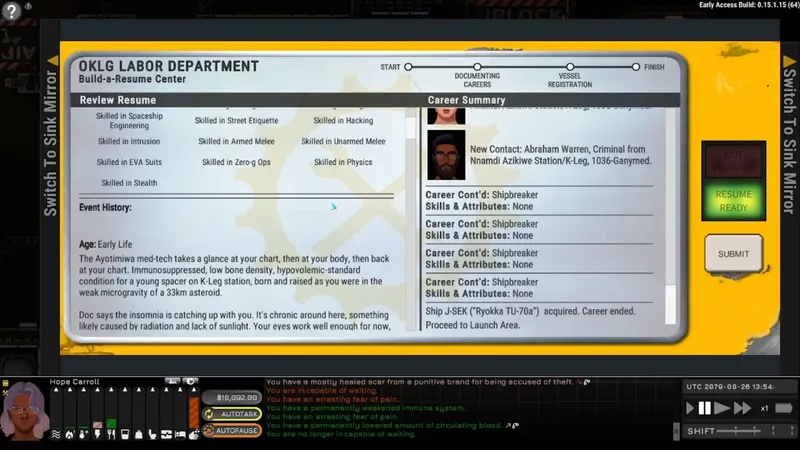
New captains do not drop straight into a cockpit. Character creation runs through the Career Kiosk and its Build-a-Resume flow: you spend fictional years building skills, traits, contacts, gear, and sometimes extra cash before age forces you onto a ship.
| Step | What it costs | Why it matters |
|---|---|---|
| Seek Adventure | 1 year per roll | Random narrative events — skills, cash, enemies, or gear |
| Work on Skills | 1–3 years each | EVA Suits, Spaceship Engineering, Piloting pay off immediately |
| Save Some Money | 1+ years | Bank cash before you need it at OKLG |
| Add / remove Traits | 1–3 years each | Trade youth for Charismatic, Clumsy, Brave, etc. |
| Seek Ship | Varies by path | Mortgage offer sets your starter hull and ~$100k debt |
| Finalize at age 47 | Automatic | Creation ends; you wake aboard with debt ledger active |
Every choice consumes years between age 18 and the forced cutoff. Work on Skills is the most predictable spend: EVA Suits speeds suit work in the boneyard, Spaceship Engineering and Mechanical Engineering shorten installs and repairs on your loan ship, and Spaceship Piloting makes the first OKLG undock less terrifying.
Seek Adventure is a gamble. Events like Rare Salvage, Shady Deal, or Occupational Hazard can drop cash, contacts, or a better tool — or saddle you with enemies and traits you did not plan for. One or two adventure rolls are fine; chaining five without skills leaves you old and untrained.
Default negatives like Feeble, Fragile, and Micro-g Hypovolemic hurt EVA tolerance and combat. Remove what you can afford. Charismatic helps later crew negotiation; Clumsy hurts every physical task aboard a cramped hull.
You do not need a perfect build for cycle one. You need: at least one engineering skill, EVA Suits if possible, a charged Pressure/EVA suit in your starting kit, and enough leftover years that you are not Old Age before launch.
Most paths end on a starter hull with roughly $100,000 of debt owed to OKLG financiers. That number is not a bug — it is the clock. Your first week is not about building a dream freighter; it is about making end-of-shift mortgage smaller than boneyard income. Ship upgrades come after solvency, not before.
After creation you wake on your moored ship at OKLG (K-Leg station) in 2079, Earth cut off by Kessler Syndrome. The station is your bank, market, permit office, and bed — treat it as home base until you can afford longer hops.
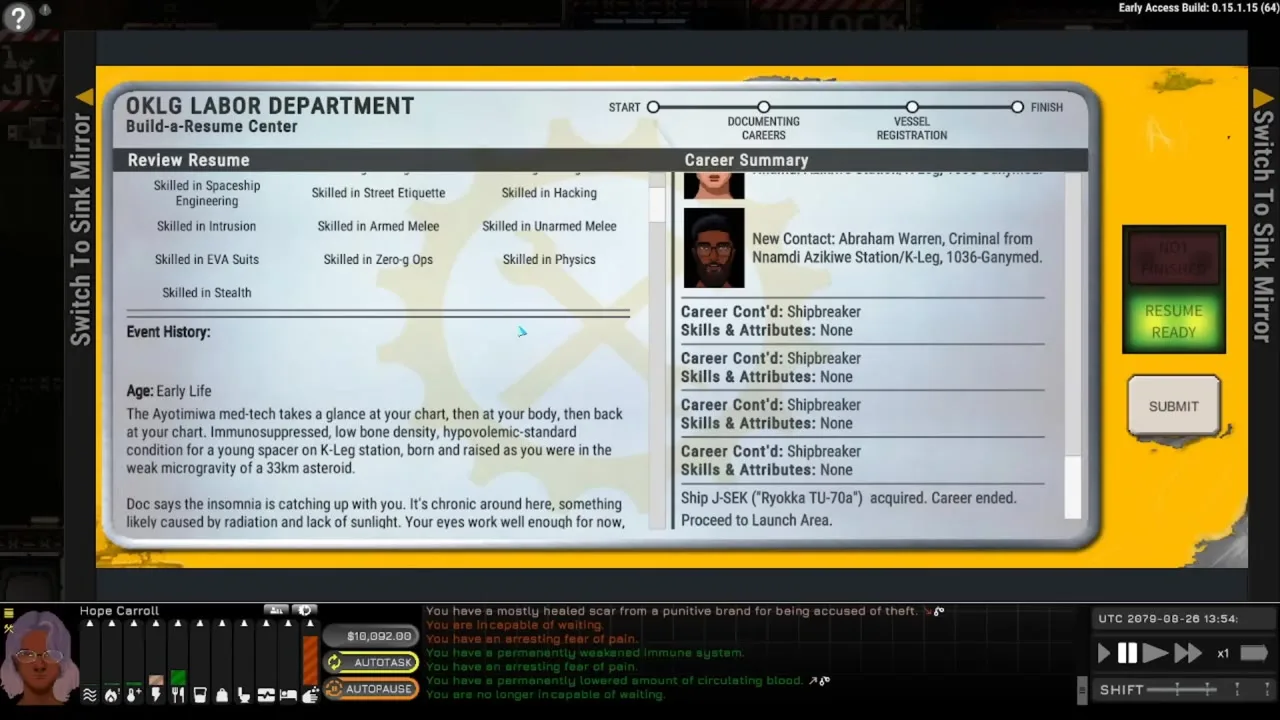
OKLG packs docking arms, kiosks, and security into one navigable ring. Pin where you sell Scrap (low-value/damaged goods), where the Licensed Salvage kiosk buys high-value parts (permit required), and where you refill EVA oxygen and ship consumables. You will walk these routes every cycle; muscle memory saves real time.
The Renbao Portal PDA tracks contacts, crew orders, photos, and ship to-dos. Install PwrViz or DmgViz cartridges when you can afford them — AR overlays for power routing and hull damage beat guessing behind walls. On day one, at minimum use the PDA to confirm which rooms lost pressure overnight.
1.0 ships with improved onboarding, but the sim still assumes you read tooltips on mooring, RCS, and airlock cycling. If a prompt mentions clearance or alignment, finish it at OKLG before you drift into traffic. A docking collision on day one can cost more than a salvage run pays.
Debt is not a late-game boss — it is the recurring weather each shift. OKLG lenders bill mortgage at the end of each 6-hour shift while you sleep, eat, and breathe station air. Solvency means your average salvage haul minus expenses beats that line item.
| Expense | Typical source | Beginner priority |
|---|---|---|
| Ship mortgage | Starter ~$100k loan | Bills each shift — non-negotiable |
| EVA O₂ refill | Boneyard runs | Cheaper than death; buy before you undock |
| Ship power / heat | Scrubbers, heaters, leaks | Fix breaches before upgrading thrusters |
| Food & water | Crew later; solo still matters | Stock cheap consumables early |
| Salvage permit | License kiosk, ~5k / 24h | Buy when hauling rare parts — see salvage guide |
| Fuel / RCS | Undock and boneyard hops | Budget round-trip before chasing distant wrecks |
First profits go to mortgage, then O₂ and tools, then hull patches. Buying a fancy thruster while mortgage compounds is how captains lose ships on cycle three. Open the ledger after every sale and pay down principal when kiosks leave you with a surplus — even small principal payments reduce tomorrow's bleed.
Early game plans should fit one wake-sleep loop: strip one derelict, sell everything, pay mortgage, sleep. Side quests, gig boards, and Ceres hops can wait until you are not one bad day from repossession. The money guide covers gigs and trading once salvage is routine.
The yellow Licensed Salvage kiosk pays more for intact modules — transponders, RCS intakes, fusion parts — but expects a 24-hour permit (~$5,000). Buy the permit on the same cycle you plan to sell high-value loot, not the day before a empty run. Illegal salvage without paperwork can trigger fines if station security stops you; details live on the salvage guide.
Boneyard income lives outside your airlock. EVA (extravehicular activity) means suit up, tether or jet across to a derelict, strip tiles and modules, and return before oxygen, suit charge, or temperature fail.
| Gear | Check before exit | Failure mode |
|---|---|---|
| Pressure / EVA suit | Charge and seals intact | Hypoxia outside — fast death |
| O₂ tank / refill | Full or spare in inventory | Mid-run blackout during strip |
| Headlamp or suit light | On before dark hull sections | Cannot see cut points or breaches |
| Crowbar / hacksaw / drill | Right tool for tile type | Stuck mid-strip, wasted O₂ |
| Cargo path | Clear route to airlock | Bulky parts block retreat |
Inner door closed → depressurize → outer open → work → outer closed → pressurize → inner open. Skipping a step vents your ship or traps you outside. On loan ships with tiny habs, one mistake can empty the only breathable room.
If you invested creation years in EVA Suits, cutting and hauling run faster — same O₂ tank lasts longer. Without it, plan shorter trips: one room stripped beats half a hull explored. You can train more in-game, but early cycles reward efficiency over ambition.
Suit temperature and ship life support interact. Cold derelicts drain suit heat; sun-facing hulls cook you. Rotate back to the airlock before the suit warning spikes. For hab management after EVA, see life support.
Your opening boneyard target should be close, depressurized already, and rich in handheld loot — not a pristine freighter requiring a tow license. Think modules you can unscrew and drag, not entire hulls.
Tier 1 — grab first: intact RCS intakes, heaters, pumps, small thruster assemblies, working tools, and EVA gear left aboard. They sell well relative to mass and fit through standard airlocks.
Tier 2 — if time allows: navigation consoles, batteries, undamaged floor/wall tiles you can install on your loan ship. Floor panels under walls add HP without new fabrication — useful for patching micrometeor hits.
Tier 3 — skip early: fusion reactor cores, full transponder/IFF assemblies, and multi-tile hull sections until you own a permit, a tow brace, and enough O₂ budget for long strips. Those are mid-game payslips — see the dedicated salvage guide.
Crowbar pops loose panels; hacksaw and angle grinder cut structure; power drill speeds fasteners. If a tile resists, check whether you need a different tool or Spaceship Engineering skill — forcing the wrong interaction wastes minutes you do not have in vacuum.
Set a hard exit at 50% O₂ or one spare tank remaining, whichever comes first. Derelicts are infinite; your first captain is not. Pack loot toward the airlock as you go so you never sprint back empty-handed.
Profitable salvage is only real once it is sold. Fly back to OKLG, moor with clearance, unload at the right kiosk, then refuel your ship and body for the next cycle.
| Kiosk | Best for | Permit? |
|---|---|---|
| Scrap kiosk | Damaged tiles, junk, low-value metal | No |
| Licensed Salvage (yellow) | Intact modules, rare parts, high value | Yes — 24 h permit |
| Fixer / traders | Specific gear, odd quest items | Varies |
| Supply vendors | O₂, food, fuel, suit parts | No |
Match relative velocity, align with the mooring point, and request clearance on the nav console. RCS taps beat long burns — loan tugs are heavy and sloppy. If you bounce off OKLG, repair before sleeping; leaks compound costs with atmosphere loss.
Split scrap from licensed goods in your cargo hold. Dumping a valuable RCS intake at the scrap kiosk because you were tired is the classic cycle-one tax. With a permit active, sell high-value pieces first — they fund mortgage and O₂ for the next week.
After mortgage, buy battery buffer, patch breaches, and route power through a fuse box before cosmetic tiles. Brownouts disable doors mid-EVA. When you are ready to wire fusion properly, move to the reactor guide; when you salvage a whole hull, read transponder before undocking.
Scan this before you sleep each cycle. Most wipes are logistics errors, not combat.
| Mistake | Fix |
|---|---|
| Undocking with no O₂ spare | Refill at OKLG every cycle — treat it like fuel |
| Ignoring end-of-shift mortgage | Sell and pay before sleep; see money guide |
| Selling rare parts at Scrap kiosk | Buy permit; use Licensed Salvage kiosk |
| EVA until O₂ hits zero | Abort at 50%; haul loot incrementally |
| Living with hull breaches | Patch floors/walls — leaks kill power and crew later |
| Flying stolen hulls without IFF | Transponder guide before leaving dock |
| Over-building before solvency | One hab, one airlock, one income loop first |
| Skipping RCS fuel math | Budget round trip to boneyard and back |
| Recruiting crew before you can pay salary | Crew guide after debt is stable |
| Chasing distant wrecks day one | Stay in K-Leg boneyard until permit income is routine |
Before every undock, say out loud: mortgage due, O₂ full, tool packed, return fuel reserved. Four checks beat ten hours of rerolling character creation.
When salvage feels safe, your next read is the full salvage guide — boneyard routes, permit timing, and high-value module tables.
Yes. Expect to fail a few debt cycles while learning EVA, power routing, and shift-end costs. The sim rewards reading tooltips and planning one cycle at a time.
Check mortgage, patch hab leaks, stock EVA O₂ and a crowbar, then run one short boneyard strip and sell at the Scrap or Licensed kiosk.
Roughly $100,000 depending on your Build-a-Resume path — end-of-shift mortgage applies until you pay principal down.
Character creation at the Career Kiosk: spend years on skills (EVA Suits, Spaceship Engineering), traits, adventure events, and gear before you inherit the loan ship.
The K-Leg boneyard — a wreck field near OKLG where derelict hulls sit ready to strip. It is the default first income source.
Not for junk sales. Buy the ~$5k / 24h Ayotimiwa permit when you strip or sell high-value modules — it covers legal salvage and Licensed kiosk rates; unlicensed runs risk NASS fines.
Steam PC · Steam Deck Verified · Workshop — controller support is listed on Steam.
Single-player. Ostranauts is a solo life-sim.
The salvage guide for derelict boarding depth, then life support and money guide once cycle one is stable.
August 16, 2026
Matched by build plan, shared topics, and guide progression — not random related links.